The Problem
You're close to the problem space. You're thinking deeply — sometimes at 3am. You have breakthrough insights constantly. But when you bring those ideas to a call or a chat, you're compressing hours of thinking into minutes of talking. The team hears the headline, but misses the whole article.
And the old way of getting ideas out of your head was painful: either you spend hours manually writing docs and going through revision cycles, or you explain your vision to someone and hope they understood it well enough to turn it into something the team can build from. Either way, fidelity is lost. The idea that arrives to the team is a shadow of the one in your head.
The New Workflow
Every time you have a great idea, your first move is to collaborate with AI — not a person.
Before you message the team, before you bring it up on a call, sit down with an AI tool and work through it together:
- Wispr Flow / Dictation — talk through your idea out loud, let it transcribe and structure your thinking
- Claude / Cowork — have a back-and-forth conversation to shape, challenge, and document your idea
- Granola — capture and structure ideas from meetings automatically
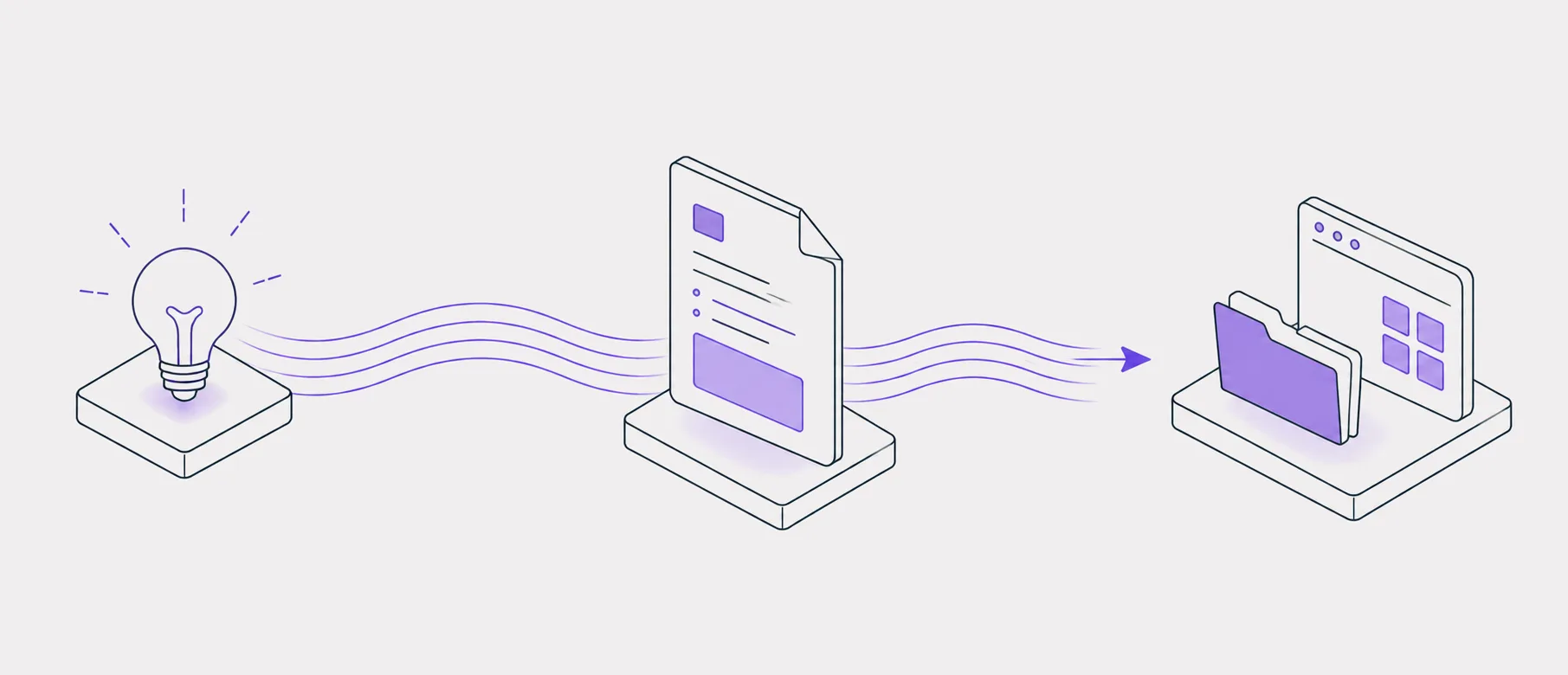
These tools work best when they're interconnected. Granola captures what you said on a call, Wispr lets you dictate follow-up thoughts, and Claude helps you shape all of it into a structured document. The goal is a continuous pipeline from your brain to a shareable asset — not copying and pasting fragments between disconnected apps. Build your toolkit so the output of one feeds into the next.
The end product should always be a written asset: a PRD, a strategy doc, a positioning brief, a go-to-market plan — something concrete, shareable, and stored where the team can find it.
What Changes
Before (old flow)
- You have an idea, bring it to a call, and hope the team absorbs it in real time.
- You spend hours manually writing a doc, then go through multiple revision cycles before it's ready.
- You explain your vision to someone, hope they capture it faithfully, and wait for them to produce an asset you can execute from.
- Context lives in your head. Standup means explaining your vision from scratch.
- Ideas get lost, diluted, or misunderstood.
After (new flow)
- You have an idea, collaborate with AI, create a structured asset, and share it with the team.
- A 15-minute AI session produces a polished, structured output.
- You co-create the asset directly with AI, preserving full fidelity. No middleman.
- Context lives in Linear and the repo. Standup becomes: "I created this PRD, please review and let's collaborate."
- Ideas are preserved with the richness and nuance you intended.
How to Do It (Step by Step)
- Have the idea. You're excited. You haven't slept. Great.
- Open Claude, Cowork, or Wispr. Talk to it the same way you'd talk to a co-founder. Say: "Let's document a go-to-market strategy. Here's what I'm thinking..."
- Let the AI structure it. It will ask good questions. It will organize your thoughts into sections, user stories, or strategy frameworks. Go back and forth until it captures what's in your head — with full fidelity.
- Save the output as a concrete asset — a PRD, a strategy brief, a positioning doc.
- Put it where the team can find it. Linear, the project repo, or the shared knowledge base for the venture.
- Then tell the team. Your standup message becomes: "I wrote up the new positioning strategy — it's in Linear. Take a look and let me know your questions."
Why This Matters
The core shift here is about fidelity. Right now, every time an idea passes through a conversation, a call, or a manual handoff, it loses resolution. Details drop out. Nuance disappears. The team ends up building from an approximation of your vision instead of the real thing.
AI collaboration compresses the entire cycle — from raw idea to structured, shareable asset — into a single session. No waiting for someone else to interpret your thinking. No multi-day revision loops. No lossy telephone game. What comes out the other side is as close to what's in your head as we can get.
And because everything is documented, the team can engage deeply and asynchronously. We can build architecture, create backlogs, and execute — all from a shared source of truth instead of a half-remembered conversation.
The One Rule
If the idea is worth sharing with a human, it's worth spending 15 minutes collaborating with AI first.
You're not spending more time. You're spending the same time — but the output is a durable, high-fidelity artifact instead of a fading memory.