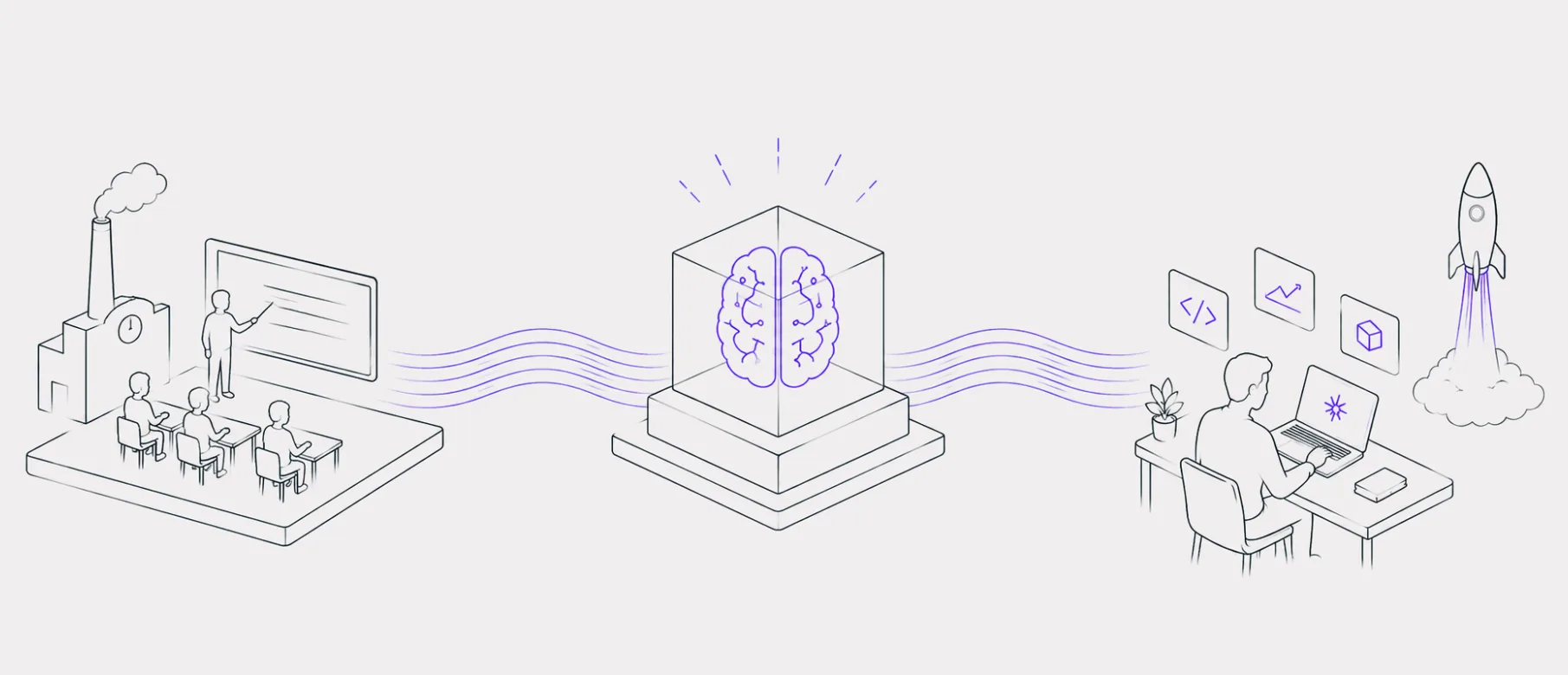
AI already feels like it knows everything. If it's not there yet, it will be soon, and it will surpass everything humanity has collectively learned. That breaks education, which was built 200 years ago to produce factory workers. The skills that matter have inverted: knowing things is cheap, knowing what to ask and whether the answer is right is everything. The people thriving with AI are the ones who learned without it. The generation growing up inside it may never develop the judgment to catch the machine when it's wrong. The window to fix this (apprenticeship models, Socratic coaching, project-based learning) is open now. It won't stay open long.
A thirteen-year-old on our team's family calls AI "the thing that knows everything." They're right. And that single fact breaks the entire premise of modern education.
The Factory We Forgot to Close
Our education system was built for factories. The Prussian model that became the template for modern schooling was designed in the 18th century to produce workers: literate enough to follow instructions, compliant enough not to question them.
Two centuries later, the system is largely intact. Kids sit in rows. Teachers talk at the slowest learner's pace. Tests measure retention of facts that any phone can retrieve in 2 seconds.
The model worked when information was scarce and labor was manual. Information is now infinite and labor is increasingly cognitive. The model isn't just outdated. It's producing the wrong capabilities for the world that already exists.
The Skills Inversion
For all of human history until about 18 months ago, knowing things was valuable. Memorizing formulas, dates, case law, medical protocols. The person who knew more had the advantage.
That's over.
Knowing everything is now the cheap part. Any AI can retrieve, synthesize, and present information faster than any human. The expensive capabilities are the ones schools barely teach: knowing what to ask, recognizing when the answer is wrong, evaluating outputs against reality, and making judgment calls with incomplete information.
We're watching this play out on our own team. The people using AI most effectively are the ones who already earned mastery the hard way. They've built financial models by hand, written code line by line, designed campaigns from scratch. They know what good looks like because they've produced it themselves.
That's the uncomfortable paradox: the generation that benefits most from AI is the one that learned without it.
The Generation That Never Struggled
Here's where it gets concerning.
A kid who grows up with "the thing that knows everything" may never develop the judgment to know when it's wrong. They'll produce polished output. Their essays will be grammatically perfect. Their presentations will look professional. And they may have no idea whether the content is accurate, original, or worth saying.
We already see this in junior employees. The output looks competent. The understanding behind it is shallow. They can prompt, but they can't evaluate. They can generate, but they can't judge.
Mastery has always required struggle. The pianist who practiced scales for 10,000 hours hears things the casual listener doesn't. The engineer who debugged systems by hand spots failure modes that the AI-assisted engineer misses. The writer who filled notebooks with bad drafts developed an internal compass for what works.
Remove the struggle and you don't get efficiency. You get a generation that can operate the machine but can't tell when the machine is lying.
The Alignment Problem Starts at Bedtime
The macro version of the AI alignment problem (how do we build superintelligence that shares human values?) has a micro version that starts in your living room.
A seven-year-old can ask an AI to help them get around parental controls. A twelve-year-old can access perspectives and content that their parents carefully filtered. A teenager can outsource their homework, their thinking, and their worldview formation to a system trained on someone else's philosophical commitments.
One of our team members grew up with parental software called "Covenant Eyes" that screenshotted anything above a G rating. Those guardrails were clunky, but they created a window for the child to develop their own values before being exposed to the full blast of the world's opinions.
That window is closing. AI makes every guardrail porous. The question for parents is the same question facing the labs: how do you embed values deeply enough that they hold when you're no longer in control?
The Apprenticeship Return
Before we invented classrooms, humans learned through apprenticeship. You worked alongside someone who had mastery. You watched how they made decisions. You earned responsibility as your judgment developed. The feedback loop was immediate and personal.
Industrial education replaced that with rows of desks and standardized tests because apprenticeship didn't scale. One master, one student, for years. Expensive. Slow.
AI changes that math. A well-designed AI tutor can deliver personalized, one-on-one coaching at scale. It can meet each learner exactly where they are, adjust in real time, and never lose patience.
But (and this is the critical caveat) only if the humans designing those systems know what mastery actually looks like from the inside. Because they earned it themselves.
The best education has always been Socratic. A mentor who builds a theory of mind of where you are, asks the right questions, and lets you struggle just enough to learn without breaking. We practice this with our own team every week: understanding someone's mental models, predicting what's frustrating them, and coaching through the specific moment where they're stuck.
AI can amplify that. It can't replace the human who knows what "stuck" looks like because they've been there.
What Actually Needs to Happen
The curriculum question ("what should we teach?") is now less important than the capability question ("what should humans be able to do that machines can't?").
Three capabilities matter more than any subject:
Evaluation. The ability to look at machine-generated output and know whether it's right, partially right, or confidently wrong. This requires domain knowledge that can only come from doing the work yourself first.
Direction. The ability to know what to build, who to build it for, and why it matters. Gaudí didn't carve every stone. He knew enough about materials, structure, and light to hold a vision. That's the skill: enough depth to steer, enough breadth to see the whole.
Judgment under uncertainty. Every interesting decision happens with incomplete information. Schools train for certainty (there's one right answer, find it). The world runs on judgment (there are 12 plausible answers, pick one and move).
The Window
We're at a specific moment. The adults alive right now are the last generation that learned to think without AI assistance. We carry something that can't be easily replicated: the muscle memory of mastery earned through struggle.
That's not nostalgia. It's a resource. And it's depreciating.
The window to redesign education (to build systems that develop evaluation, direction, and judgment before handing kids the most powerful cognitive tool in history) is open now. It won't stay open. Every year that passes, more kids form their cognitive foundations with AI as a crutch rather than a tool.
We're building toward this at our compound in Colombia: Montessori-inspired, project-based, coached by humans who've done the work, augmented by AI that amplifies rather than replaces the struggle.
It's small. It's local. It might not scale. But the alternative (sending another generation through a 200-year-old factory model into a world that factory model was never designed for) has guaranteed bad outcomes.
The bet is worth making here too.
This piece grew out of a conversation between the Katapult and LIT teams about what we're seeing on the ground: adults who learned the hard way thriving with AI tools, while younger team members struggle to evaluate what the machine gives them. The education implications hit us all at once.