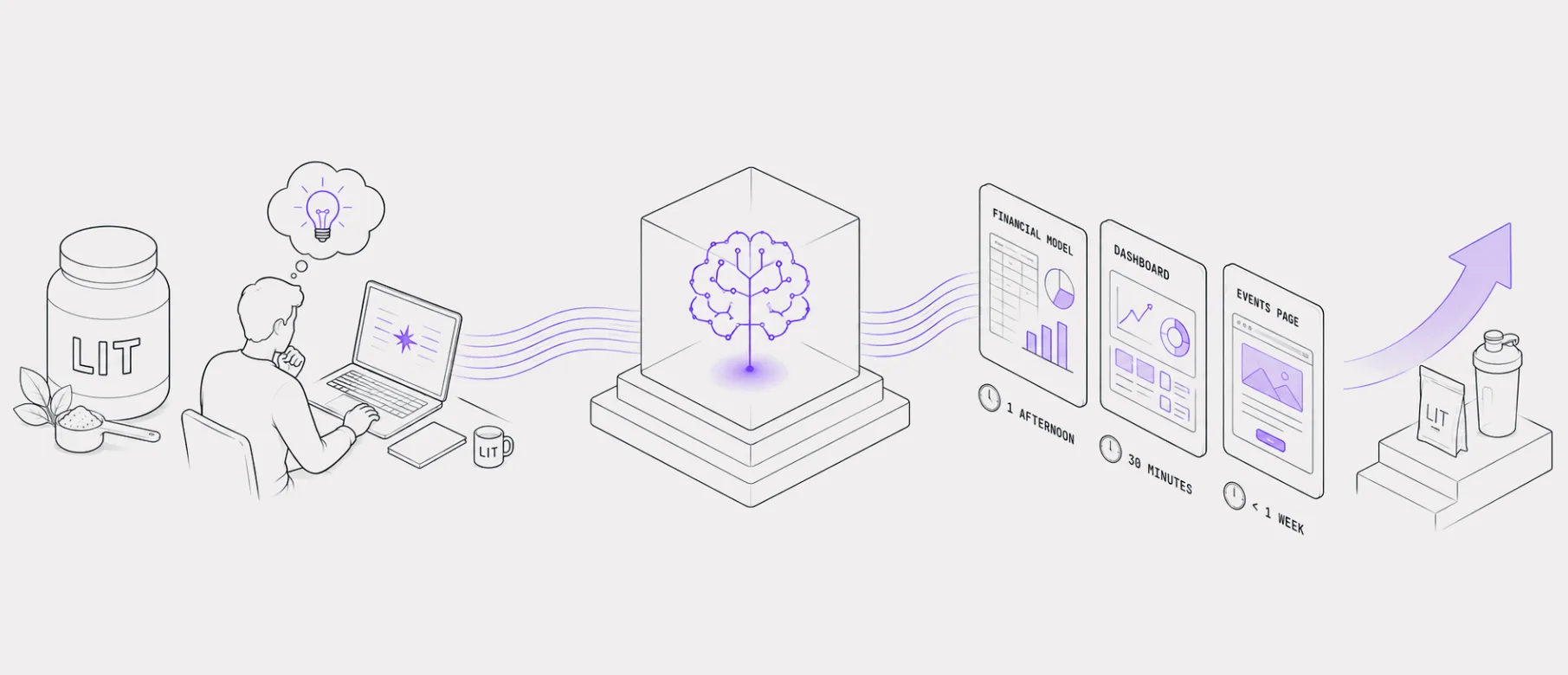
A small, high-growth, CPG brand in Spain rewired how their team works in 3 weeks. Financial models that took 2 weeks now take an afternoon. A dashboard that wouldn't have existed got built in 30 minutes. An events page went from zero to deployed in Shopify in under a week. The hard part wasn't the technology. It was building the habit, pushing through the frustration valley, and learning when to escalate. The pattern that worked: human expertise sets direction, AI handles assembly, human judgment evaluates the output. LIT is probably one of a few hundred CPG brands doing this right now. In 18 months, it'll be table stakes.
The Company
LIT is a direct-to-consumer electrolyte and superfood brand based in Spain. Small team. Physical product. Retail distribution through boutique gyms, yoga studios, and wellness centers. The kind of company where one person handles B2B sales, another manages the Shopify store, and everyone wears 4 hats.
Three weeks ago, they started an agentic transformation. Here's what actually happened.
What "Agentic Transformation" Means in Practice
It means rethinking the sequence of how work gets done.
The old pattern: have an idea, spend hours (or weeks) building the deliverable manually, present it, iterate, ship.
The new pattern: have an idea, describe the outcome to an AI collaborator, iterate on the output in minutes, spend your human time on judgment, taste, and strategy.
The difference sounds incremental on paper. In practice, it's a phase change.
The Breakthroughs
The Financial Model (Week 3, Bloomer)
One team member needed a comprehensive financial model and shareholder presentation for a company restructuring. Previously, this would have required a team: someone building the model in Excel, someone designing the deck, someone pulling the data together. Estimated timeline: 2 weeks minimum.
He did it in an afternoon. Built the financial model, generated the presentation, and briefed the lawyers. On the same call, he showed the lawyers how to use the tools themselves.
The breakthrough wasn't the output. It was the cognitive shift: realizing that the expertise to know what the model should contain and who the audience is was the valuable part. The assembly was no longer the bottleneck.
The Dashboard That Shouldn't Exist (Week 3, Vero)
Another team member needed to understand unit economics from Shopify sales data. She downloaded flat files from Shopify, fed them into Claude, and got a comprehensive Excel breaking down units sold, comped units, and margins.
Then she went further. She fed in a B2B sales projection and asked for an interactive dashboard. Claude built her a full web-based tool with margin calculators, camp projections, and gross margin analysis.
This is a tool that would have taken a front-end developer, a designer, and a data analyst roughly a month to build. She did it in 30 minutes. Her partner, watching from across the room, estimated the equivalent report alone would have taken him 2 weeks. The dashboard wouldn't have existed at all.
The Events Platform (Week 3, Julie)
The team needed an events page for their Sunday wellness community. One team member took it from zero to deployed in Shopify, in stages:
Started with a brief (what the page needed to communicate, who the audience was). Then wireframes. Then a designed HTML version with responsive layout, typography, and image selection. Then exported to Figma for design editing. Then converted to Shopify's Liquid templating language and deployed as an editable section in their store.
Each stage was a collaboration: human direction, AI execution, human evaluation, AI iteration. The entire pipeline (brief to deployed, editable Shopify page) happened in under a week.
The Pattern
Every breakthrough followed the same structure:
The human brought the expertise. They knew what the financial model needed to show. They knew which Shopify metrics mattered. They knew what the events page should communicate. Domain knowledge was the starting point.
The AI handled the assembly. Building the spreadsheet, coding the dashboard, generating the HTML, converting to Liquid. The work that previously required specialized teams and weeks of calendar time.
The human evaluated the output. Caught errors. Adjusted the framing. Made taste decisions. Directed the next iteration. This step was where mastery mattered most, because the AI produced polished output that looked right whether or not it was right.
What's Actually Hard
The technology isn't the bottleneck. The cognitive shift is.
Forgetting to use it. The B2B sales lead described walking into gym visits and forgetting to record them with Granola (an AI meeting tool). She'd leave a meeting, realize she forgot, and lose the data. It's not a tool problem. It's a habit problem. The neural pathway that says "I'm about to do a task, let me first think about how AI changes this" hasn't formed yet.
The frustration valley. Every person on the team hit a point where the tools broke, threw errors, or did something stupid. The instinct is to abandon it and do things the old way. The teams that push through this valley are the ones that get the compounding returns. The ones that don't, stay manual.
Knowing when to escalate. The tools have rough edges: bugs, UX inconsistencies, settings that don't work the way you'd expect. A team member spent time trying to connect Google Drive to Claude, fighting errors that weren't her fault. The intervention that mattered was someone with deeper technical context saying, "that's a known bug, do this instead." Without that support, she would have concluded the tool doesn't work.
Security intuition. One team member wanted to find a Shopify plugin online. The immediate coaching: don't install plugins from unknown sources that ask for API keys. The AI ecosystem is at the "computer virus" stage of maturity. Every plugin that requests credentials is a potential attack vector. The team needed to learn when to escalate to someone with security context before connecting sensitive systems.
The Measurement
At the end of week 3, the team was asked: if these tools disappeared tomorrow and you had to go back to the old way of working, how disappointed would you be?
The answers were unanimous and emphatic.
One team member's partner (watching from across the room as she worked) summarized it: a week's worth of deliverables, produced in 45 minutes. A dashboard that wouldn't have been possible at all. A report that would have taken 2 weeks, generated in an afternoon.
The velocity increase is real. But the more interesting shift is qualitative: the team stopped thinking about tasks and started thinking about outcomes.
What Makes This Different
Most AI adoption stories are about individual productivity. Someone uses ChatGPT to write emails faster. A developer uses Copilot to autocomplete code.
LIT's transformation is organizational. It's a small team collectively shifting how they think about work, supporting each other through the frustration valley, sharing wins and workarounds in real time, and building institutional knowledge about when and how to deploy these tools.
Three characteristics make this work:
Psychological safety around being lost. The team regularly admits confusion, frustration, and failure. Nobody pretends to have it figured out. This matters because the tools change weekly and expertise is genuinely distributed. The person who's lost today coaches someone else tomorrow.
Coaching, not training. The sessions aren't lectures. They're live, hands-on problem-solving. Someone shares their screen, explains what they're trying to do, and gets coached through the specific moment where they're stuck. This is the apprenticeship model applied to AI adoption: Socratic, personalized, immediate.
Culture that rewards the shift, not just the output. The team celebrates the cognitive breakthrough (the moment someone "gets it") as much as the deliverable. The breakthrough isn't the dashboard. It's the realization that you can go from idea to deliverable without a team and a month of calendar time.
Where It Goes
Week 3 is early. The compounding hasn't fully kicked in yet.
The next phase is connecting the tools together: Shopify data flowing directly into Claude without manual downloads, sales visit recordings automatically generating pipeline updates, content creation informed by real-time sales data.
The team is also beginning to build their own plugins: custom tools that encode their specific workflows so that what required coaching in week 3 happens automatically in week 12.
This is what agentic transformation actually looks like. A series of small breakthroughs, accumulated across a team, compounding week over week, until the old way of working becomes unimaginable.
LIT is probably one of a few hundred CPG brands on the planet doing this right now. In 18 months, it'll be table stakes.
The advantage belongs to whoever starts first.
This case study documents the first 3 weeks of LIT's AI transformation, guided by the Katapult team. The breakthroughs, frustrations, and patterns described here are drawn directly from weekly team workshops. Names are used with permission.